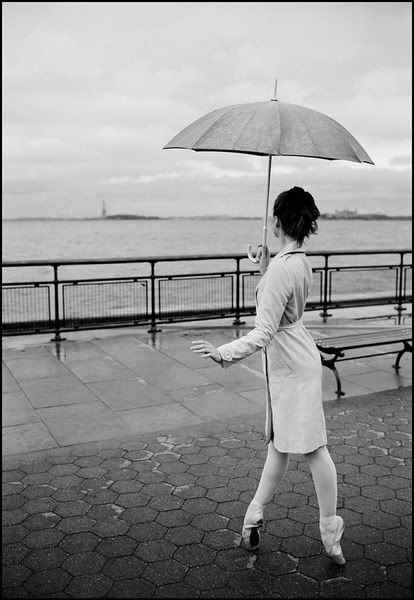
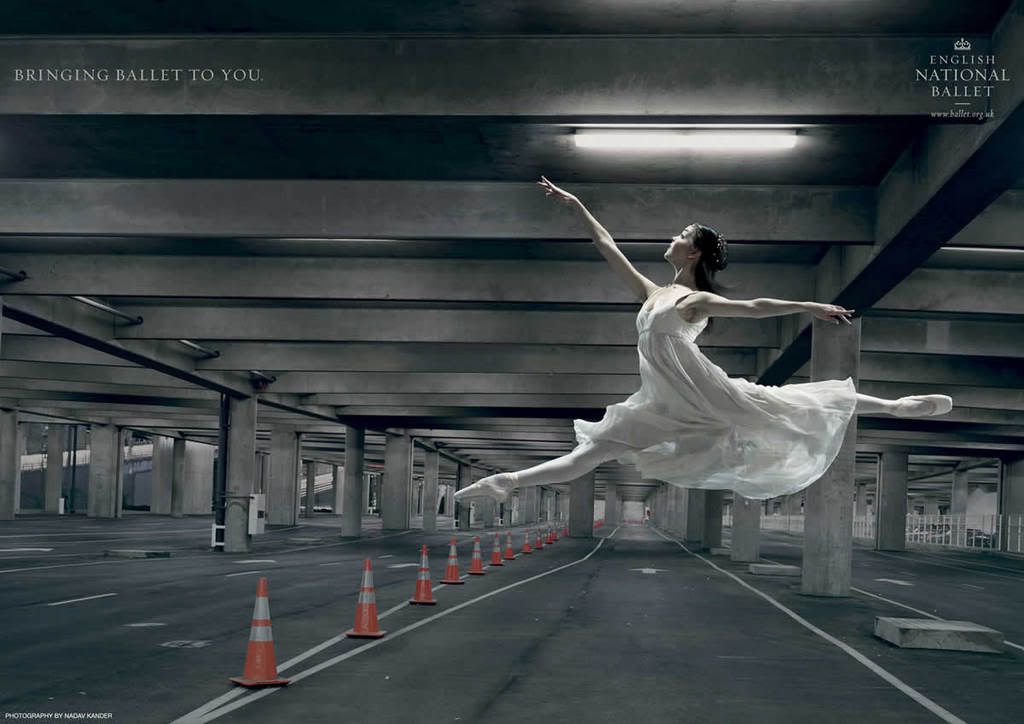
Ballet is one of the most misconceived art forms that exists today’s world. Many think it is just another one of those types of dance where one would just prance around and try to look pretty. No one can really understand the hard work, dedication, long hours, and pain that goes into this art form to make it look so easy. As a student of ballet, I have experienced and seen the blood, sweat, and tears that goes into ballet.
When I was presented with the opportunity to expose others to my world of ballet in the form of a concept-folio, I knew I had to take the chance. It has proved to be more difficult than I had anticipated, but it poses as a good challenge. I enjoy the chance to write about ballet and find beautiful pictures of ballerinas and every aspect of ballet. It is my love and my life and I would not change that for the world. I want to use this concept-folio as a way to show everyone how much I love ballet and how much work goes into my art form to make it look beautiful.
Monday, March 10, 2008

Tuesday, March 4, 2008


Narrative
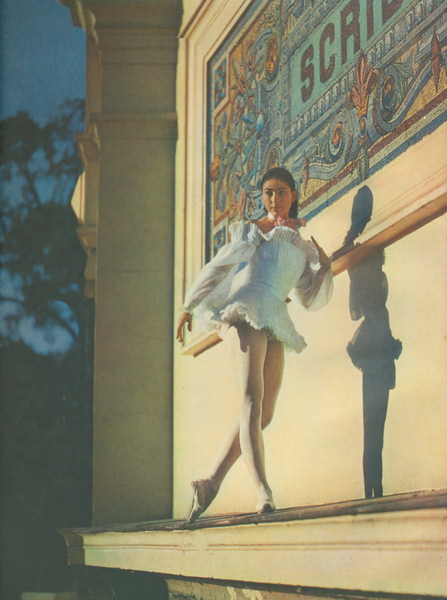 “No! You’re doing it all wrong; I don’t know why I chose you for this part. Again, from the top, and please try not to look like a dying cat.”
There was no end to my constant torture. I came to the studio everyday, day after day, to do the same barre, same center adage, same variation, and same ballet. Nothing changed. And everyday of my continuous torment, I was yelled at, screamed at, at the top of his lungs, bellowing so loudly that my eardrums hurt. It seemed like he was never satisfied by what I did, no matter how hard I tried. I put my soul into each rehearsal, but it was never enough. He was never through with me until he made me cry so much that I could never shed another tear even if my life depended on it, until tomorrow.
Once he let me leave, I ran out of the studio, and up the stairs. My aching feet, blistered heels, and bleeding toes crammed into tiny shoes carried me up them, and my wretched strait jacket stopped my breathing. I stood, clutching the building, thinking about what had occurred after yet another seven hours of suffering. I gathered myself and asked myself, “Why do you put yourself through this everyday?” I answered in a heartbeat. “Because I love it.” Everyday I woke up to put myself through another nightmare, but for some reason, even though I have the freedom to leave, I kept coming back to repeat this wretched dream. Hanging onto the building, looking down at the small city, dressed in the shoes and pannier that make me a goddess, I felt like it is alright. Everything in the world made sense on top of that building. My hopes, dreams, and wishes all became clear as I stared down at the rushing city beneath my feet. I regained the courage that I never thought I would have; enough to build confidence and return to my studio.
As I walked back through the heavy, gray double doors to the academy, I no longer felt the weight on my shoulders that I usually felt. Everything looked lighter, more vivid and colorful. When I walked into the studio, the other girls whispered and pointed and laughed, but I tried hard to ignore it. “Has the crybaby decided to grow up yet?” He’d ask, just like every other day. Instead of turning around and leaving once again, I nodded. He acknowledged my courage and demanded the pianist to begin his accompaniment. I danced the steps, performed them to death, used every inch of my body to express myself, using every drop of my energy. I felt lighter, like I had lifted some weight off of myself: no guilt, no sadness, no pain, no anything. Just a sole feeling of accomplishment, like I had done something, and now my life was complete. When the music ended and I dancing ceased, he stared at me for a while, long and hard, like he was trying to see through me or see what was inside of me. After what felt like centuries, he finally said, “Good. We will continue tomorrow.” I could have sworn I saw him smile at me with a twinkle in his eye.
Monday, February 25, 2008
Critique 2
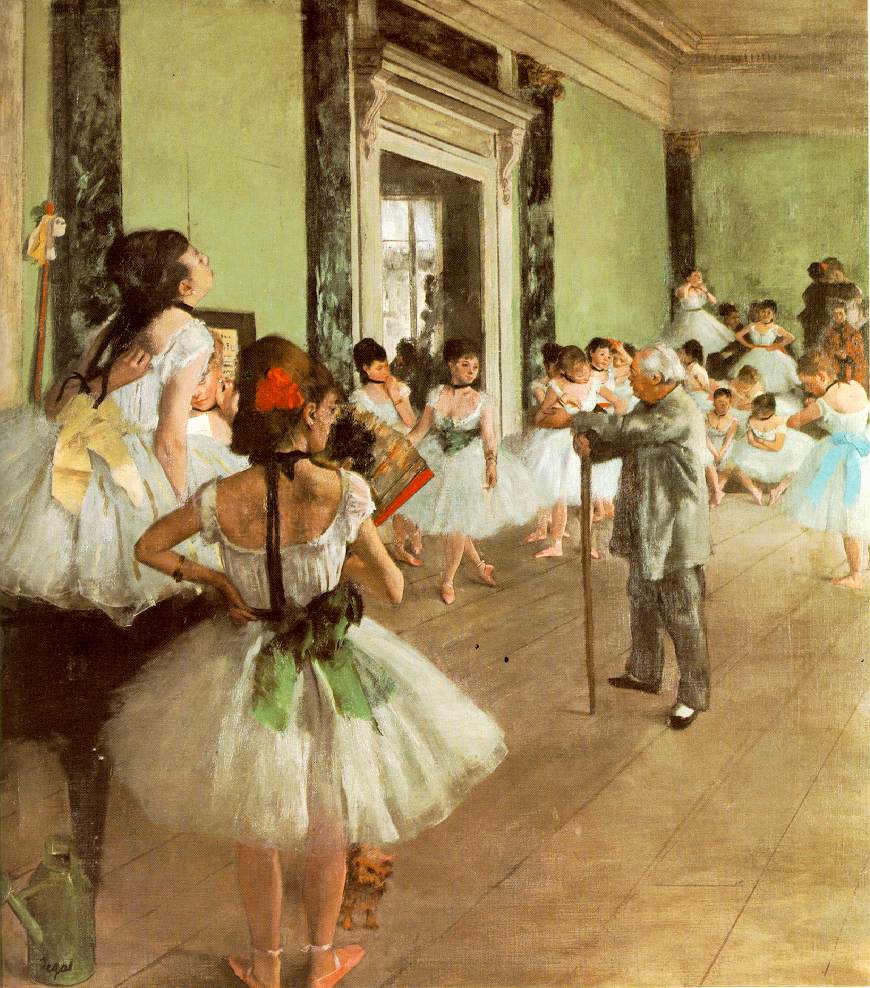
 “Ballet Rehearsal” was easily one of Edgar Degas’ best compositions. It is a portrayal of a ballet rehearsal; however, things seem somewhat uneventful because a crowd of dancers is formed around the girls dancing. This gouache and pastel on canvas was created in 1875 is known as one of his more famous compositions of ballet. Ballet Rehearsal now resides in the George G. Frelinghuysen Collection in New York.
Degas’ composition “Ballet Rehearsal” depicts a ballet rehearsal that seems to be rather dull. One may interpret this composition as a boring rehearsal because many people are crowded around the dancers who are rehearsing. The field of the composition is set in various values of green, and on the right, has a mixture of greens and yellows. As the field of the composition progresses to the left, the shade of green becomes darker. On the bottom left, there is a group of dancers with a man all gathered in juxtaposition. The dancers are emphasized by their tutu’s lighter color, which sets them apart from the field and the other characters. There is one dancer who is bending over, but her backside is facing the viewer. For some reason her tutu seems to attract the eye, possibly because it is highlighted with lighter shades. The crowd of dancers who are gathered seem like they are not paying attention to what is happening. There is a man standing off to the right side; however, only half of him is seen in the composition. Another man who is in the middle of the crowd of dancers is dressed in only values of brown with his shirt as a bright red color, which is different from the image’s color scheme. The focal point is the ballerina who is shown rehearsing. Most of the other characters are looking in her direction, which attracts the viewer’s eyes to her. The perspective of this composition is closer than a seat from the audience, so it seems to have been from the perspective of someone who was onstage. Degas’ use of different values of green and his contrast of the dancers and men are elements that make his composition effective. This composition shows a normal rehearsal that depicts other dancers as bored, so they would watch the rehearsal, or rude, in which they act as a distraction to those who are attempting to rehearse. Also, although this is a detailed composition, it leaves many questions that were not answered. For example, is it that the girls are bored, or could they be rude to those dancing? In addition, why is there half of a man seen on the right side of the composition? Is he of importance to the rehearsal, or is he just there as a bystander? Also, why is it that the dancers are not paying attention? Degas’ “Ballet Rehearsal” uses his talent in drawing ballerinas mixed with rebellious mannerisms of young dancers to create an attractive composition.
Wednesday, February 6, 2008
Critique
 “The Rehearsal” can be seen as Edgar Degas’ best work. It portrays an adage in a regular ballet class. Painted sometime around 1873 to 1878, the oil on canvas composition is one of Degas’ famous ballet paintings. He is categorized as an impressionist painter who concentrated on the general impression produced by a scene and the use of unmixed primary colors and small strokes to stimulate actual reflected light. The composition “The Rehearsal” is now situated at the Fogg Art Museum in Harvard University in Cambridge, Massachusetts.
Degas’ composition depicts a typical ballet adage in the center. It is only painted in earth tones, which sets a relaxing state, and there is a definite contrast between the dancers, who are in white, and the violinist, who is in black. As in impressionist works, natural lighting is used, most emphasized from the light emanating from the large windows. Inside of the studio, it is somewhat dark, while outside, it is bright, which could suggest a darker side to the art of ballet, such as working so hard to the point of uncomfortable pain. The painting is from the perspective of a corner of the studio, and all of the dancers seem to be spaced to the left of the composition. The dancers are placed in juxtaposition even though there is extra space in the studio. The focal point of Degas’ composition is the dancer who is closest to the viewer. Her form appears to be the clearest and the viewer is only able to see her face. She also has the darkest shadow and the lightest pigment of pink shoes and tights. Furthermore, the colors of the ribbons, flowers, and bows of the dancers create harmony from their pleasing combination of colors. Degas’ attractive color scheme, use of natural lighting, and contrast compose an effective piece; however, the blurriness of it makes it weaker.
Nevertheless, Edgar Degas’ “The Rehearsal” still leaves many unanswered questions. Firstly, one would wonder why the concentration of the picture is focused to the left of the composition. Perhaps this is because the eye is more attracted towards the left. Maybe it is because Degas wanted to emphasize the natural lighting from the large window. Also, one would question why there is no instructor present in the picture. Perhaps this is because the dancers were unattended which would also explain why some dancers are not paying attention, or the instructor was out of the painter’s view. Lastly, one may ask why the studio is so dark. Is Degas aiming to imply something by doing so, or is he only attempting to accentuate the natural lighting. Degas’ work utilizes the impressionist’s skill in order to portray a life like adagio using natural lighting.
Monday, February 4, 2008

Subscribe to:
Posts (Atom)